I am an environmental and energy economist. My research focuses on topics such as air pollution, environmental regulation, climate change, ecosystems, energy efficiency, electricity and renewable energy — much of it field-based in India. I am a Professor at the Department of Economics at the University of Warwick.
University of Warwick · Energy Policy Institute, University of Chicago
New Research
The latest working papers and journal articles.
The Value of Clean Water: Experimental Evidence from Rural India
American Economic Review
Anant Sudarshan (with Fiona Burlig, Amir Jina)
A 60,000-household randomized trial delivering treated water to rural homes: at low prices take-up topped 90%, and willingness to pay proved far higher than earlier indirect estimates implied.
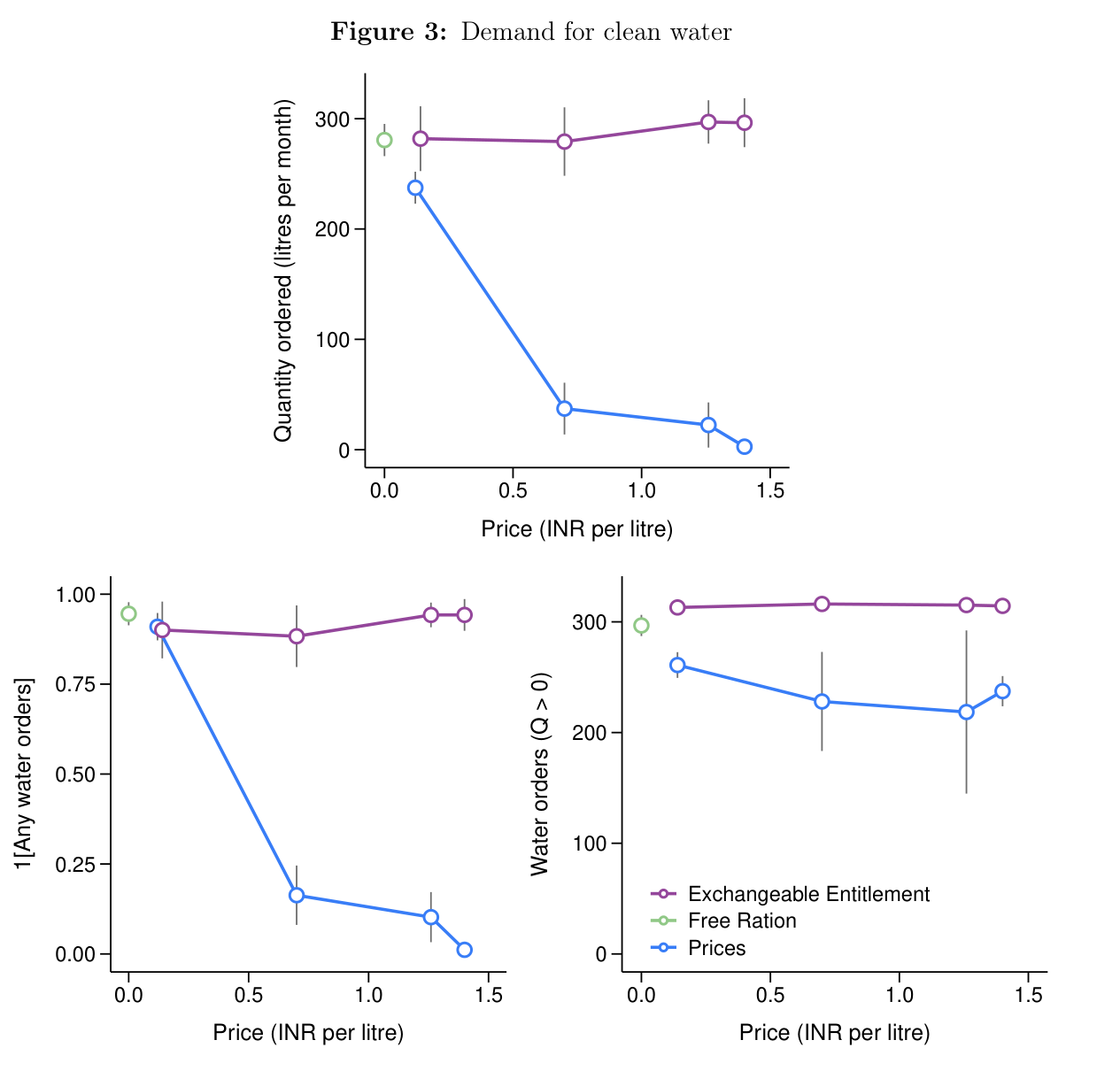
Over 2 billion people lack clean drinking water. Existing solutions face high costs (piped water) or low demand (point-of-use chlorine). Using a 60,000-household cluster-randomized experiment, we test an alternative approach: decentralized treatment and home-delivery of clean water to the rural poor. At low prices, take-up exceeds 90 percent, sustained throughout the experiment. High prices reduce take-up but are privately profitable. We experimentally recover revealed-preference measures of valuation: willingness-to-pay is several times higher than prior indirect estimates, and willingness-to-accept is larger and exceeds marginal cost. Self-reported health measures improve accordingly. On a cost-per-DALY basis, free water-delivery regimes appear highly cost-effective.
Demand falls steeply with price, yet stays high under an exchangeable quota — Fig. 3.
2026
Paying for Power
Working paper
Anant Sudarshan (with Fiona Burlig)
When the state threatens penalties it can’t enforce, who pays? Two field experiments in Madhya Pradesh show the credibility of the messenger — not the threat itself — drives whether households pay their electricity bills.
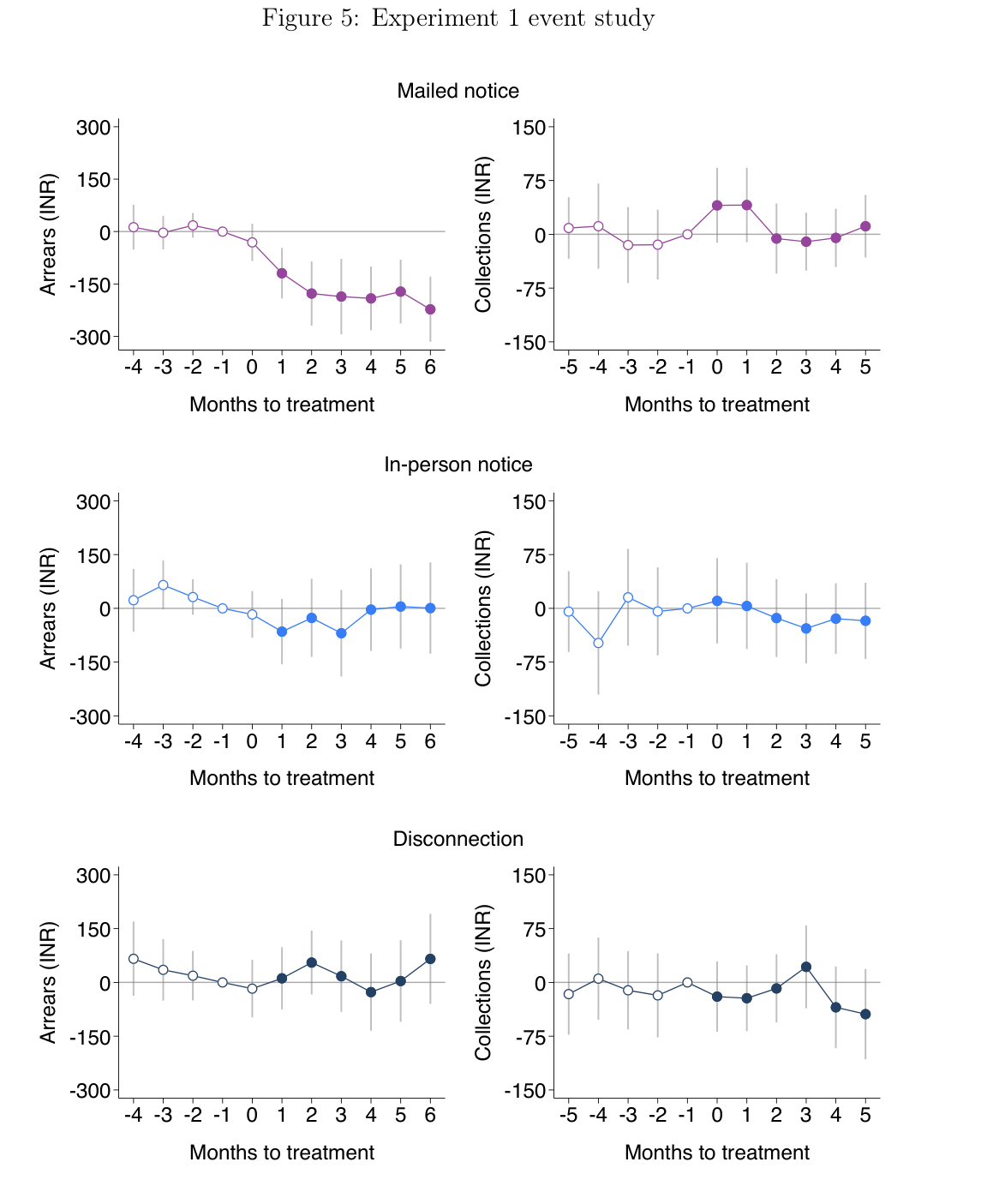
Developing-country governments routinely attempt to collect revenue using threats they cannot systematically enforce. We study how citizens assess the credibility of such empty threats in the context of payment for electricity in Madhya Pradesh, India, where state-run utilities recovered only 60 cents per dollar of power supplied. Using two field experiments covering 30,000 households with high arrears, we show that the household response to a threat depends on the state's choice of messenger. Legal threats delivered by local linesmen — state agents with a history of ignoring non-payment — have no effect. Yet identical notices sent by registered mail, bypassing linesmen, reduce arrears by 11.4 percent among recipients, a 241 percent return on investment. A second experiment a year later shows these effects are dynamic: consumers originally visited by a linesman do not respond to future notices, while those never exposed to linesmen do. Low-credibility state agents can render threats ineffective.
A mailed legal notice cuts arrears; an in-person notice from linesmen does not — Fig. 5.
2026
Can Pollution Markets Work in Developing Countries? Experimental Evidence from India
Quarterly Journal of Economics
Anant Sudarshan (with Michael Greenstone, Rohini Pande, Nicholas Ryan)
We built and ran the world’s first market for particulate air pollution — a cap-and-trade scheme among industrial plants in Surat — as a randomized controlled trial, and found it cut emissions while lowering firms’ costs.
Market-based environmental regulations are seldom used in low-income countries, where pollution is highest but state capacity is often low. We collaborated with the Gujarat Pollution Control Board to design and experimentally evaluate the world's first particulate-matter emissions market, covering industrial plants in a large Indian city. There are three main findings. First, the market functioned well: treatment plants, randomly assigned to the market, traded permits to become significant net sellers or buyers, and after trading held enough permits to cover their emissions 99% of the time, compared to just 66% compliance under the command-and-control status quo. Second, treatment plants reduced emissions, relative to control plants, by 20% to 30%. Third, the market reduced abatement costs by an estimated 11%, holding emissions constant. Together, the pollution reductions and low costs imply mortality benefits that exceed the market's costs by at least twenty-five times.
Treatment plants (blue) fall below control (grey) once the market begins — Fig. 5.